Penong’s Philippines Menu Prices Updated 2026

✓ Updated Prices last updated May 2026 — sourced from official Penong’s Philippines channels
Penong's Philippines Menu 2026
🍗 Cebuano Grilled Cuisine

Penong’s Menu with Prices

11
Categories
Visayan
Cuisine
₱35
Starts From
2026
Updated

Looking for the complete Penong’s Philippines menu with prices? You’ve come to the right place. We’ve compiled the full 2026 Penong’s menu with updated prices across all 11 categories — sourced directly from official Penong’s Philippines channels.

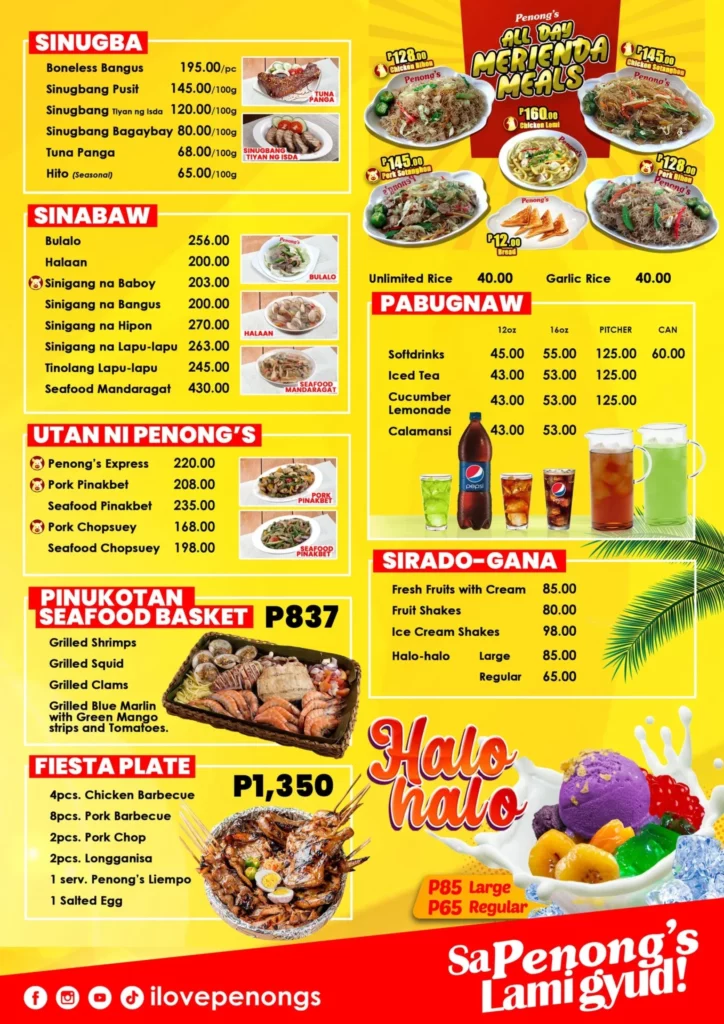
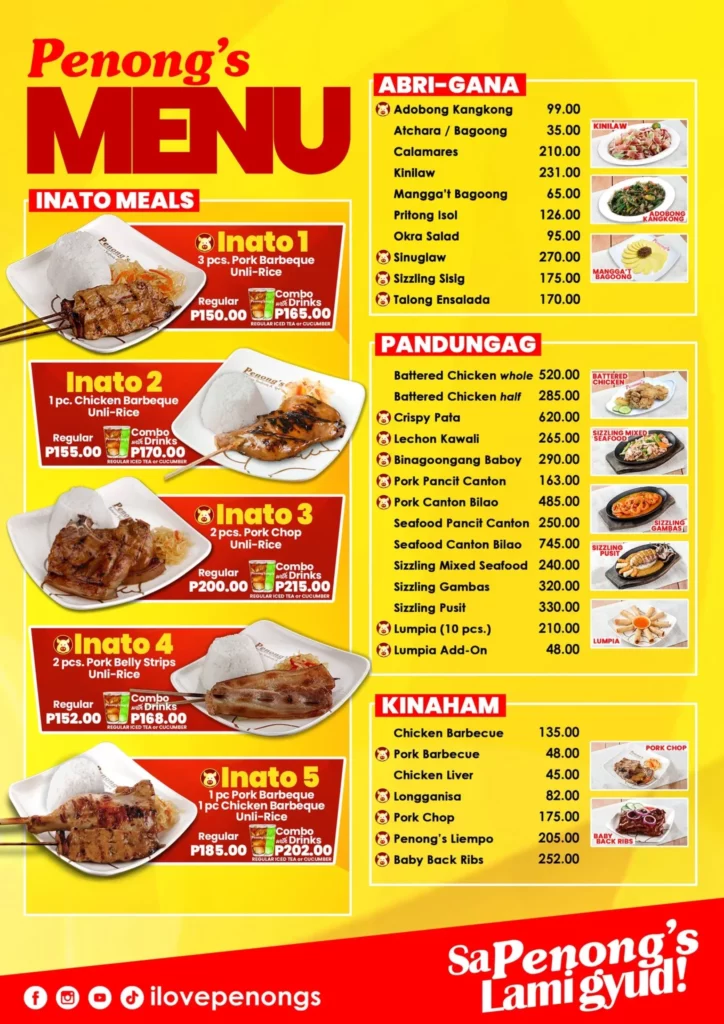
Penong’s is one of the Philippines’ most beloved Cebuano restaurant chains — built around the authentic barbecue, grilled seafood, and Visayan comfort food traditions of Cebu. The menu spans Inato Meals (combo plates), Abri-Gana (starters & appetizers), Pandungang (main courses), Kinaham (grilled meats), Sinugba (grilled seafood), Sinabaw (soups), Utan ni Penong’s (vegetables), Pabugnaw (drinks), and Sirado-Gana (desserts).

Prices range from ₱35 (Atchara) to ₱682 (Seafood Mandaragat). Scroll down for the complete updated menu.

🍖

Penong’s Visayan Menu Guide — Cebuano Terms Explained

Inato (Cebuano: “ours / our way”) — Penong’s proprietary combo meal format combining a main dish with rice and sides, the Cebuano equivalent of a value set meal. Abri-Gana (Cebuano: “appetizer / to whet the appetite”) — starters and small plates eaten before the main course. Pandungang (Cebuano: “main course / the main food”) — heavier main dishes. Kinaham (Cebuano: “grilled over fire”) — grilled meats on skewers or open flame. Sinugba (Cebuano: “grilled / charcoal-grilled”) — specifically charcoal-grilled seafood; sinugba is the Cebuano word that gave “inihaw” (Tagalog) its equivalent. Sinabaw (Cebuano/Filipino: “soup / broth dish”) — soupy preparations including Sinigang, Bulalo, and Tinola. Utan ni Penong’s (Cebuano: “Penong’s vegetables”) — vegetable and mixed dishes. Pabugnaw (Cebuano: “to cool down / cold drinks”) — cold beverages. Sirado-Gana (Cebuano: “after-meal / dessert course”) — desserts. Kinilaw — Visayan raw fish ceviche: fresh fish “cooked” by acid (coconut vinegar / sukang tuba) — the acid denatures the fish proteins producing a texture similar to heat-cooked fish without heat. Sinuglaw — a uniquely Visayan hybrid dish combining Sinugba (grilled pork) with Kinilaw (raw fish in vinegar) in the same plate. Bagaybay — tuna sperm sac, a Cebuano delicacy grilled on skewers. Halaan — clams in broth. Pinakbet — Ilocano vegetable stew of bitter melon, eggplant, squash, and string beans in bagoong (shrimp paste) sauce.

🍽️

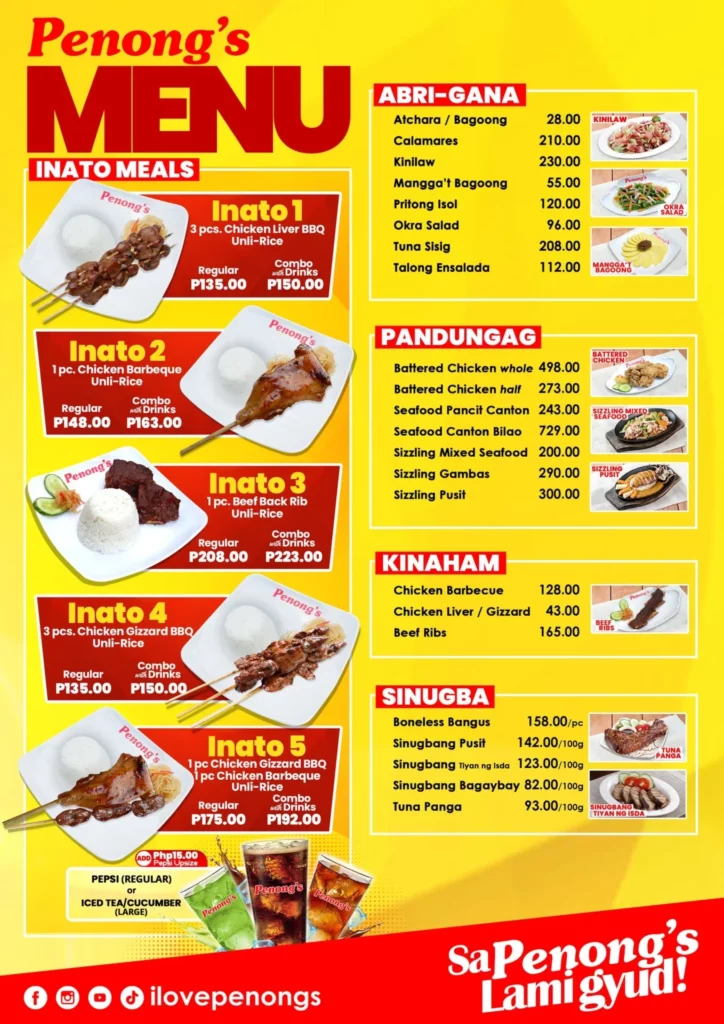
Penong’s Inato Meals Menu With Prices

Menu ItemsPrice
Inato 3₱ 237.00
Inato 5₱ 222.00
Inato 2₱ 187.00
Inato 4₱ 185.00
Inato 1₱ 182.00
🥗

Penong’s Abri-Gana Prices

Menu ItemsPrice
Sinuglaw₱ 297.00
Kinilaw₱ 254.00
Calamares₱ 231.00
Sizzling Sisig₱ 193.00
Talong Ensalada₱ 187.00
Pritong Isol₱ 139.00
Adobong Kangkong₱ 109.00
Okra Salad₱ 105.00
Manggo’at Bagoong₱ 72.00
Atchara₱ 39.00
Penong's Menu Penong's Menu Philippines
🍖

Penong’s Pandungang Menu Prices

Menu ItemsPrice
Crispy Pata₱ 682.00
Battered Chicken Whole₱ 572.00
Pork Canton Bilao₱ 534.00
Sizzling Pusit₱ 363.00
Sizzling Gambas₱ 352.00
Binagoongang Baboy₱ 319.00
Battered Chicken Half₱ 314.00
Seafood Pancit Canton₱ 275.00
Lechon Kawali₱ 292.00
Sizzling Mixed Seafood₱ 264.00
Seafood Mixed Seafood₱ 264.00
Lumpia 10 pcs₱ 231.00
Pork Pancit Canton₱ 180.00
Lumpia Add-On₱ 53.00
🔥

Penong’s Kinaham Prices

Menu ItemsPrice
Baby Back Ribs₱ 277.00
Penong’s Liempo₱ 226.00
Pork Chop₱ 193.00
Chicken Barbecue₱ 149.00
Longganisa₱ 91.00
Chicken Liver₱ 50.00
Pork Barbecue₱ 53.00
🐟

Penong’s Sinugba Menu Prices

Menu ItemsPrice
Boneless Bangus₱ 215.00
Sinugbang Pusit₱ 160.00
Sinugbang Isda₱ 132.00
Sinugbang Bagaybay₱ 88.00
Tuna Panga₱ 75.00
Hito₱ 72.00
Penong's No Pork Menu Penong's No Pork Menu Philippines
🍲

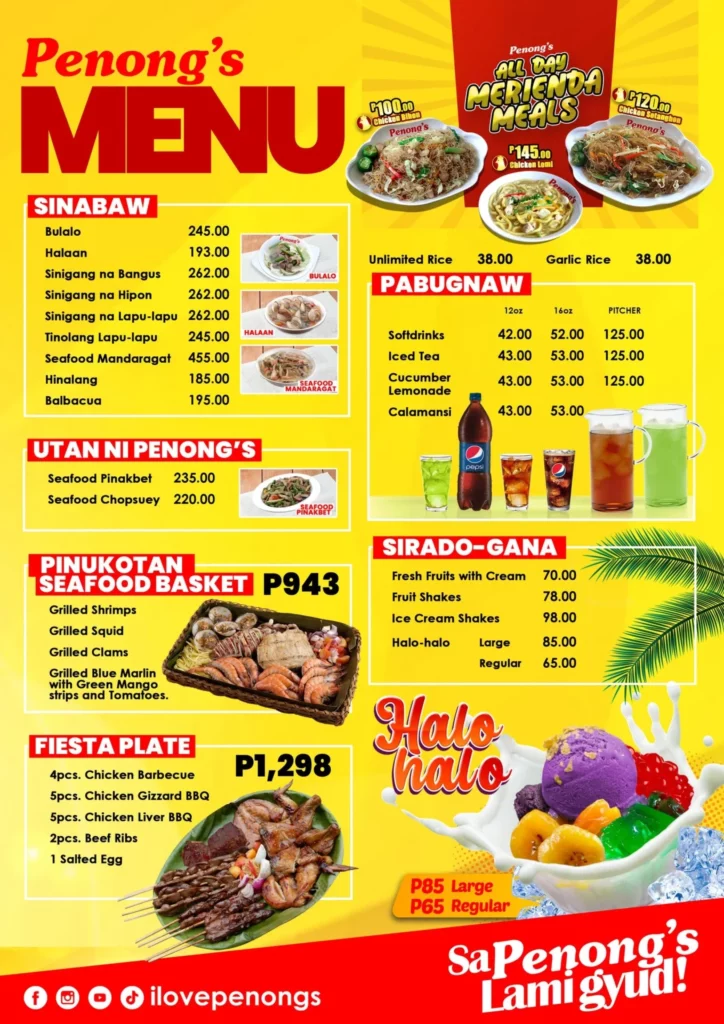
Penong’s Sinabaw Prices

Menu ItemsPrice
Seafood Mandaragat₱ 473.00
Sinigang na Hipon₱ 297.00
Sinigang na Lapu-Lapu₱ 290.00
Bulalo₱ 282.00
Tinolang Lapu-Lapu₱ 270.00
Sinigang na Baboy₱ 224.00
Sinigang na Bangus₱ 220.00
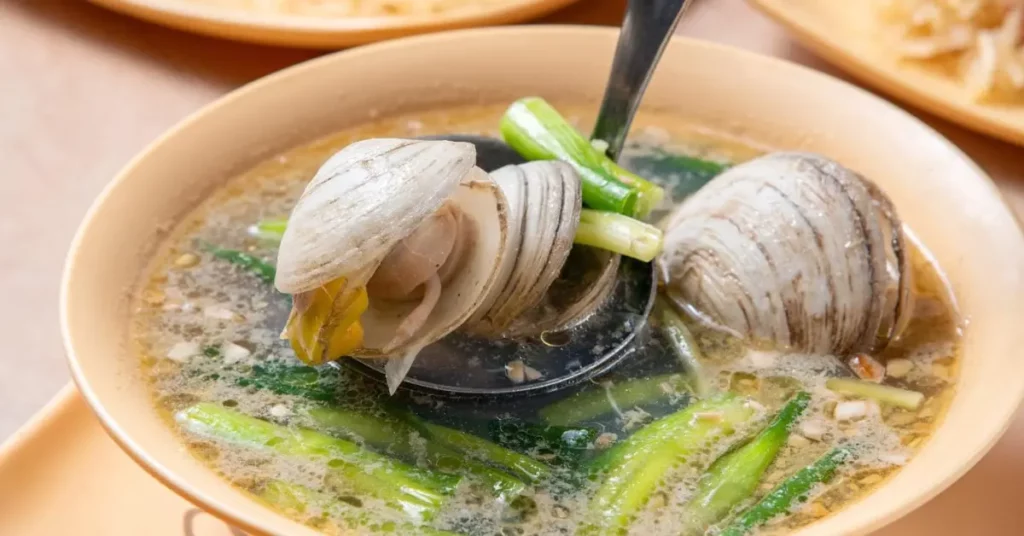
Halaan₱ 220.00
🥬

Penong’s Utan ni Penong’s Menu Prices

Menu ItemsPrice
Seafood Pinakbet₱ 259.00
Penong’s Express₱ 242.00
Pork Pinakbet₱ 229.00
Seafood Chopsuey₱ 218.00
Pork Chopsuey₱ 185.00

See Also: Mad Mark’s Menu

🥤

Penong’s Pabugnaw Prices

Menu Items12oz16ozPitcher
Softdrinks₱ 50.00₱ 61.00₱ 138.00
Iced Tea₱ 48.00₱ 59.00₱ 138.00
Cucumber Lemonade₱ 48.00₱ 59.00₱ 138.00
Calamansi₱ 48.00₱ 59.00
🍨

Penong’s Sirado-Gana Prices

Menu ItemsPrice
Ice Cream Shakes₱ 108.00
Fresh Fruits with Cream₱ 94.00
Halo-Halo₱ 94.00
Fruit Shakes₱ 88.00

⭐ Our Favorite Items at Penong’s Menu

Sinuglaw
₱ 297.00
The most uniquely Visayan dish at Penong’s and the one that best represents Cebuano food culture — Sinuglaw is a portmanteau of Sinugba (charcoal-grilled pork) and Kinilaw (raw fish in vinegar), combining both preparations in the same plate. The combination works because of contrasting textures and flavors: the warm, smoky, charred grilled pork against the cold, tangy, acid-“cooked” raw fish creates a hot-cold and smoky-bright contrast in every bite. Kinilaw (the raw fish component) is a Visayan version of ceviche — fresh fish cut into cubes and marinated in sukang tuba (coconut palm vinegar) or calamansi juice, which denatures the surface proteins of the fish producing a texture similar to heat-cooked fish without applying heat. The acid-denaturation is a chemical reaction that changes protein structure — technically a form of cooking. Sinuglaw is a dish unique to the Visayas and Mindanao — it does not exist in Tagalog or Ilocano cuisine, making it the most regionally specific item on the Penong’s menu.
Penong’s Liempo
₱ 226.00
The signature grilled meat at Penong’s — Liempo (pork belly) grilled over charcoal is the most popular Filipino barbecue cut because pork belly has the ideal fat-to-meat ratio for grilling: the alternating layers of subcutaneous fat and muscle (the “three-layer” structure of belly pork) render during grilling, self-basting the meat and preventing dryness, while the fat cap on the skin side crisps and chars from the direct flame. The Penong’s version follows the Cebuano grilling tradition — a marinade of soy sauce, calamansi, garlic, sugar, and banana ketchup, applied in multiple layers during grilling so that each application caramelizes before the next is added. This builds up the characteristic sticky, charred exterior glaze. Penong’s Liempo is the most ordered single item at the restaurant and the most distinctly Cebuano expression of the universal Filipino liempo.
Sinigang na Hipon
₱ 297.00
The most premium soup at Penong’s — Sinigang (from the Tagalog/Filipino root “sigang” = to cook in souring liquid) is a tamarind-soured broth soup with vegetables (kangkong, sitaw, labanos, eggplant) and a primary protein. Hipon (shrimp) Sinigang uses fresh whole shrimp whose shells are left on during cooking — the shrimp shells release chitin-bound flavor compounds and a natural sweetness into the broth that produces a more complex, more deeply flavored sinigang than boneless shrimp. The tamarind sourness (from tartaric and citric acid in the tamarind pulp) is balanced by the natural sweetness of the shrimp and the glutamates released from the shrimp shells. At Penong’s — a Cebuano restaurant — sinigang follows the Visayan preference for a slightly less sour, more broth-forward version than the intensely tart Manila-style. At ₱297, the highest-priced soup and the most satisfying complete broth meal at Penong’s.
Kinilaw
₱ 254.00
The most culturally specific dish at Penong’s — Kinilaw (Visayan/Cebuano: from kilaw = to eat raw) is the Visayan ceviche: fresh fish (typically tuna, tanigue, or lapu-lapu) cut into cubes and mixed with sukang tuba (coconut palm vinegar), ginger, onion, chili, and coconut milk. The acid in the vinegar denatures the surface proteins of the fish — changing its texture from raw to “cooked” without heat, the same chemical process as Peruvian ceviche or Japanese tataki. The coconut palm vinegar (sukang tuba) is the key differentiator: unlike the cane or sugarcane vinegar used in Tagalog dishes, sukang tuba has a more mellow, slightly funky, lower-acid flavor that allows the fresh fish flavor to remain dominant rather than being overpowered by acidity. Kinilaw is consumed throughout coastal Visayas and Mindanao — it is one of the oldest Filipino food preparations, predating Spanish colonization.
Bulalo
₱ 282.00
The most warming soup at Penong’s — Bulalo is a Southern Tagalog (Batangas) beef bone marrow and shank soup, slow-boiled for 3–5 hours until the collagen from the bones dissolves into a rich, silky, naturally thick broth and the bone marrow becomes spreadably soft. Bone marrow is the fatty tissue inside beef femur bones — it is approximately 80% fat but a fat structurally different from intramuscular beef fat: bone marrow fat is particularly rich in oleic acid (the same monounsaturated fat as olive oil) and contains unique flavor compounds that produce a rich, buttery, neutral-tasting fat that melts at body temperature. The traditional way to eat Bulalo is to use the narrow end of a spoon to scoop the marrow directly from the bone and spread it on rice — the Bulalo “experience” is as much about the marrow as it is about the broth. At Penong’s, a Cebuano restaurant offering a Batangas classic, the Bulalo signals range — cooking beyond the Visayan tradition.
Sinugbang Bagaybay
₱ 88.00
The most distinctly Cebuano item on the Sinugba section — Bagaybay is the tuna sperm sac (milt), a Cebuano delicacy that is rarely found on restaurant menus outside of Visayas and Mindanao. The tuna sperm sac has a creamy, soft, slightly fatty texture when grilled — the exterior chars lightly from the charcoal heat while the interior remains soft and custard-like. The flavor is mild, slightly briny, and delicately fishy — more neutral than tuna flesh itself because the milt has a higher fat content and lower myoglobin content. Bagaybay is one of the most culturally specific items in Cebuano food culture — it represents the Visayan tradition of utilizing the whole fish (isda), including parts that other culinary cultures discard. Eating Bagaybay at Penong’s is the most authentic Cebuano food experience available at the restaurant — at ₱88, accessible to any diner willing to try something genuinely local.
⚠️

Is Penong’s Philippines Halal?

No — Penong’s Philippines is not Halal Certified. Pork is central to the menu — Penong’s Liempo, Lechon Kawali, Crispy Pata, Baby Back Ribs, Binagoongang Baboy, Sinigang na Baboy, Pork Barbecue, and pork-based Pancit Canton are featured throughout all sections. Muslim diners are advised accordingly.

About Penong’s Philippines

Penong’s is one of the Philippines’ most beloved Cebuano restaurant chains — built around the authentic barbecue, grilled seafood, and comfort food traditions of Cebu and the Visayas. The brand name “Penong’s” is a familiar diminutive of the Filipino name Alfonso or Eufronio — the kind of homey, personal name that signals a family restaurant rather than a corporate chain. The Visayan category names throughout the menu (Inato, Abri-Gana, Pandungang, Kinaham, Sinugba, Sinabaw, Pabugnaw, Sirado-Gana) are a deliberate linguistic choice — Penong’s presents its menu in Cebuano rather than Tagalog or English to signal regional identity and cultural authenticity.

The Kinaham (grilled) and Sinugba (charcoal-grilled seafood) sections are the heart of the brand. Penong’s built its reputation on affordable, well-marinated charcoal barbecue — particularly the Pork Barbecue (₱53 per stick), Chicken Barbecue (₱149), and Penong’s Liempo (₱226) — all marinated in the Cebuano style and cooked over live charcoal rather than gas, producing the authentic smoky flavor that distinguishes Cebuano barbecue from its Tagalog equivalents.

The presence of Sinuglaw (₱297) and Kinilaw (₱254) on the Abri-Gana section, and Bagaybay (₱88) on the Sinugba section, signals that Penong’s is not a simplified tourist-friendly Filipino restaurant but one that serves the full range of Visayan food culture — including the more adventurous regional specialties that most Metro Manila restaurants would not include on their menus.

❓ Frequently Asked Questions
Penong’s is famous for Cebuano barbecue and Visayan cuisine. Signature items: Sinuglaw ₱297 (grilled pork + kinilaw hybrid), Penong’s Liempo ₱226, Sinigang na Hipon ₱297, Kinilaw ₱254, Bulalo ₱282, Sinugbang Bagaybay ₱88. Affordable barbecue: Pork Barbecue ₱53 per stick. Inato Meals from ₱182. Not Halal Certified. Facebook: ilovepenongs.
Sinuglaw ₱297 — a uniquely Visayan dish combining Sinugba (charcoal-grilled pork) + Kinilaw (raw fish “cooked” in coconut palm vinegar) in the same plate. The warm smoky grilled pork contrasts with cold tangy acid-cured fish. Kinilaw uses sukang tuba (coconut palm vinegar) to denature fish proteins — the same chemical process as ceviche. Sinuglaw does not exist in Tagalog or Ilocano cuisine — exclusively Visayan. The most regionally specific item at Penong’s.
All category names are in Cebuano (Bisaya): Inato = “our way” combo meals. Abri-Gana = appetizers. Pandungang = main courses. Kinaham = grilled meats. Sinugba = charcoal-grilled seafood. Sinabaw = soups. Utan ni Penong’s = vegetables. Pabugnaw = cold drinks (“to cool down”). Sirado-Gana = desserts (“after-meal”). The Cebuano naming is intentional — Penong’s signals Visayan cultural identity rather than presenting a generic Filipino menu.
Kinilaw ₱254 — Visayan raw fish “ceviche”: fresh fish cubes marinated in sukang tuba (coconut palm vinegar), ginger, onion, chili, and coconut milk. The vinegar acid denatures fish proteins producing a cooked-like texture without heat. Sukang tuba (coconut palm vinegar) is milder and less acidic than cane vinegar — allows fresh fish flavor to stay dominant. One of the oldest Filipino food preparations, predating Spanish colonization. Found throughout coastal Visayas and Mindanao.
Sinugbang Bagaybay ₱88 — tuna sperm sac (milt), a Cebuano delicacy grilled on skewers over charcoal. Soft, creamy, slightly fatty texture when grilled — exterior chars, interior stays custard-like. Mild, slightly briny flavor. Higher fat content than tuna flesh. Found almost exclusively on menus in Visayas and Mindanao — represents the Cebuano tradition of whole-fish utilization. The most authentically Cebuano item on the menu. At ₱88, the most accessible regional specialty at Penong’s.
Yes — Penong’s is available for delivery through GrabFood and Foodpanda at available branches. For branch locations and operating hours, visit their Facebook page at facebook.com/ilovepenongs. Not Halal Certified — pork is present throughout the menu including Liempo, Crispy Pata, Baby Back Ribs, and Pork Barbecue.

Official Sources


Ready to Find Your Next Favorite Restaurant?

500+ restaurants. 8 cuisines. Always updated. Always free.

Kain na! 🇵🇭

Scroll to Top